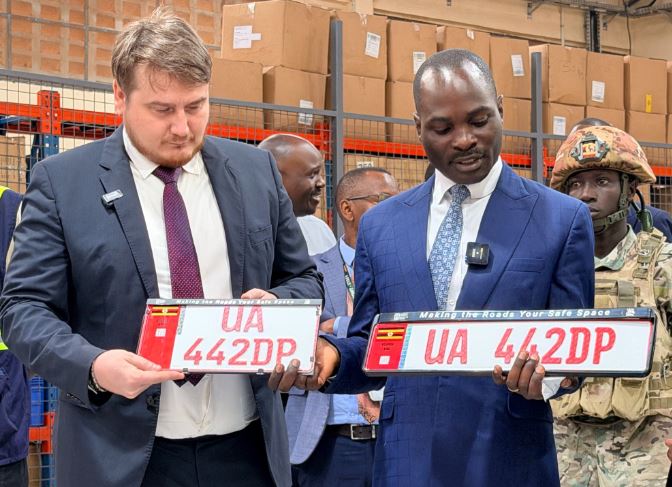
State Minister for Transport Fred Byamukama during inspection of the digital number plate production facility on Monday , July 06th 2026.
By Joseph Kiggundu
KAMPALA — Parliament’s Committee on Physical Infrastructure has ordered Auditor General Edward Akol to begin an immediate preliminary audit of the Intelligent Transport Management System (ITMS) and submit findings by Tuesday next week amid concerns over the project’s ownership, operations and financing.
The directive was issued on Thursday, October 15, 2026, when Akol appeared before the committee to explain why his office had not audited the project involving a Russian company contracted to supply and install digital number plates for vehicle identification and tracking.
The committee, chaired by Mwine Mpaka (NRM, Mbarara South Division), questioned the delay, demanding scrutiny of the system even though the government has reportedly not yet committed public funds to its implementation.
Akol attributed the delay partly to a lack of documentation, saying his office received the project agreement only on Tuesday, October 13.
“We did not have adequate information to do this audit,” Akol told the committee.
He also acknowledged that earlier engagements with the Office of the President concerning the project had not been documented, making it difficult for his office to establish a clear audit trail.
The Auditor General further cited staffing limitations, explaining that although his office has 600 employees, only 450 are directly involved in field engagements with entities subject to audit.
Akol said the latest communication from the Office of the President indicated that ITMS was still in its pilot phase, with no government funds appropriated or disbursed for implementation. The project was reportedly being financed by the investor.
However, MPs questioned why the pilot status should prevent an examination of the system’s design, installation, operational arrangements and financing structure.
Mpaka directed the audit team to start work immediately and submit a preliminary written report within the stipulated period, even if a comprehensive examination could not be completed by the deadline.
He instructed the Auditor General to formally document any obstacles encountered during the process, including cases where access to information or project facilities was denied.
“If you are denied access, you put it in writing that our office has been denied A, B, C, D, and we capture it the way it is,” Mpaka said.
The committee pledged to provide the Auditor General with the project’s needs assessment and the agreement signed between the government and the company to facilitate the inquiry.
Dr Samuel Opio (NRM, Kole North) said an initial audit could establish whether the system meets the government’s requirements by examining its specifications, installation and actual operations before it is fully rolled out.
Assistant Auditor General James Bantu, however, cautioned that the timeframe was insufficient for a comprehensive audit because of the project’s technical complexity. He said auditors would need to obtain information from accounting officers and give them an opportunity to respond to any issues raised.
The latest directive follows a committee decision on Wednesday, October 14, to have officials from the Auditor General’s office record statements with Parliament Police’s Criminal Investigations Department over the failure to audit the ITMS project.
The preliminary audit is expected to help Parliament establish the project’s implementation status and clarify questions surrounding its technical arrangements, financial commitments and accountability before a wider rollout.