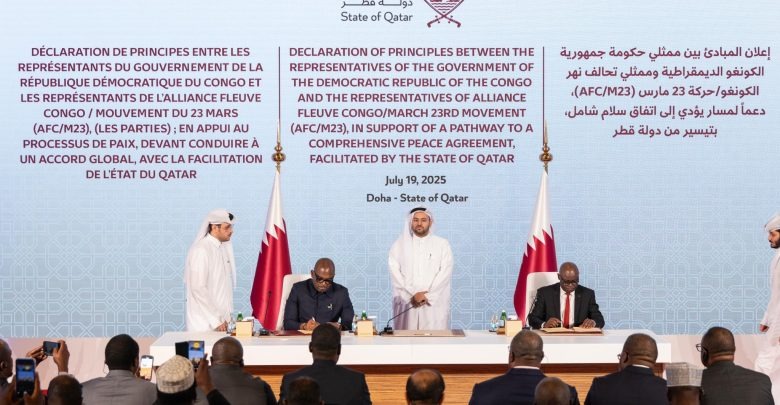
KINSHASA.The Democratic Republic of Congo and the AFC/M23 rebel alliance have agreed on a roadmap for completing negotiations under the Doha peace framework, offering fresh momentum to efforts to end years of fighting in the country’s mineral-rich east.
The roadmap was developed after five days of talks held in Switzerland from August 17 to 21, attended by representatives of the Congolese government and AFC/M23, alongside officials from Qatar, the United States, Switzerland, Togo—acting as the African Union mediator—and the African Union Commission.
In a joint statement dated August 21, the parties said they had reviewed progress and challenges in implementing the Doha Framework for a Comprehensive Peace Agreement, signed on November 15, 2025.
“Following this evaluation, the parties developed a roadmap setting out sequenced steps and timelines for negotiations under the Doha Framework Agreement,” the statement said
The two sides committed themselves to flexibility and creativity within the existing negotiating structure, but did not disclose the new deadlines or identify which outstanding protocols would be handled first.
They said the order in which the remaining protocols are negotiated would not determine their importance, suggesting that politically sensitive questions—including the restoration of state authority, disarmament, prisoner exchanges, humanitarian access and transitional security arrangements—remain unresolved.
Ceasefire verification
The parties reported progress in operationalising the Expanded Joint Verification Mechanism Plus, or EJVM+, which is intended to investigate alleged ceasefire violations
A secretariat for the mechanism has been established, while a reconnaissance mission was conducted on August 20 with logistical support from the United Nations peacekeeping mission, MONUSCO
The first EJVM+ ceasefire-verification mission was scheduled for August 24 in Minembwe, a volatile area of South Kivu that has witnessed repeated fighting involving armed groups and forces aligned with the rival parties.
Kinshasa and AFC/M23 also agreed to develop a standardised method for reporting alleged ceasefire violations.
Both sides have repeatedly accused each other of breaching previous truces, complicating diplomatic attempts to halt the conflict.
They further agreed to create a mechanism to periodically assess implementation of their obligations and resolve difficulties arising under the Doha framework.
The November agreement established a foundation for negotiations through eight protocols rather than constituting a final settlement.
The African Union later urged the parties to conclude the six outstanding follow-on protocols without delay. African Union
Fighting persists
The latest diplomatic movement comes as AFC/M23 retains control of large areas of eastern Congo, including Goma and Bukavu, the capitals of North and South Kivu respectively.
The rebels’ rapid territorial expansion since early 2025 produced one of Congo’s gravest security crises in decades and allowed the movement to establish administrative structures in areas under its control.
Fighting and alleged ceasefire violations have persisted despite the Doha process and a separate United States-mediated agreement between Congo and Rwanda.
Kinshasa, the United Nations and Western governments accuse Rwanda of supporting AFC/M23 with troops and weapons. Kigali denies backing the rebellion and says its security is threatened by armed groups operating from Congolese territory.
The conflict has displaced millions of people and disrupted trade and humanitarian operations across the Great Lakes region. Its proximity to Uganda, Rwanda and Burundi also raises the risk of further regional instability.
The two Congolese parties thanked Qatar, the United States, Togo, Switzerland and the African Union Commission for supporting efforts to restore peace in eastern Congo.
Their roadmap, however, will be judged by whether the planned verification missions take place, ceasefire violations decline and the outstanding protocols move from negotiation to implementation. Previous agreements have repeatedly stalled amid battlefield advances, mutual distrust and disagreements over territorial control