By Joseph Kiggundu
President Yoweri Kaguta Museveni has implored Egyptian investors to invest in Uganda’s economy, particularly in infrastructure development and value addition.
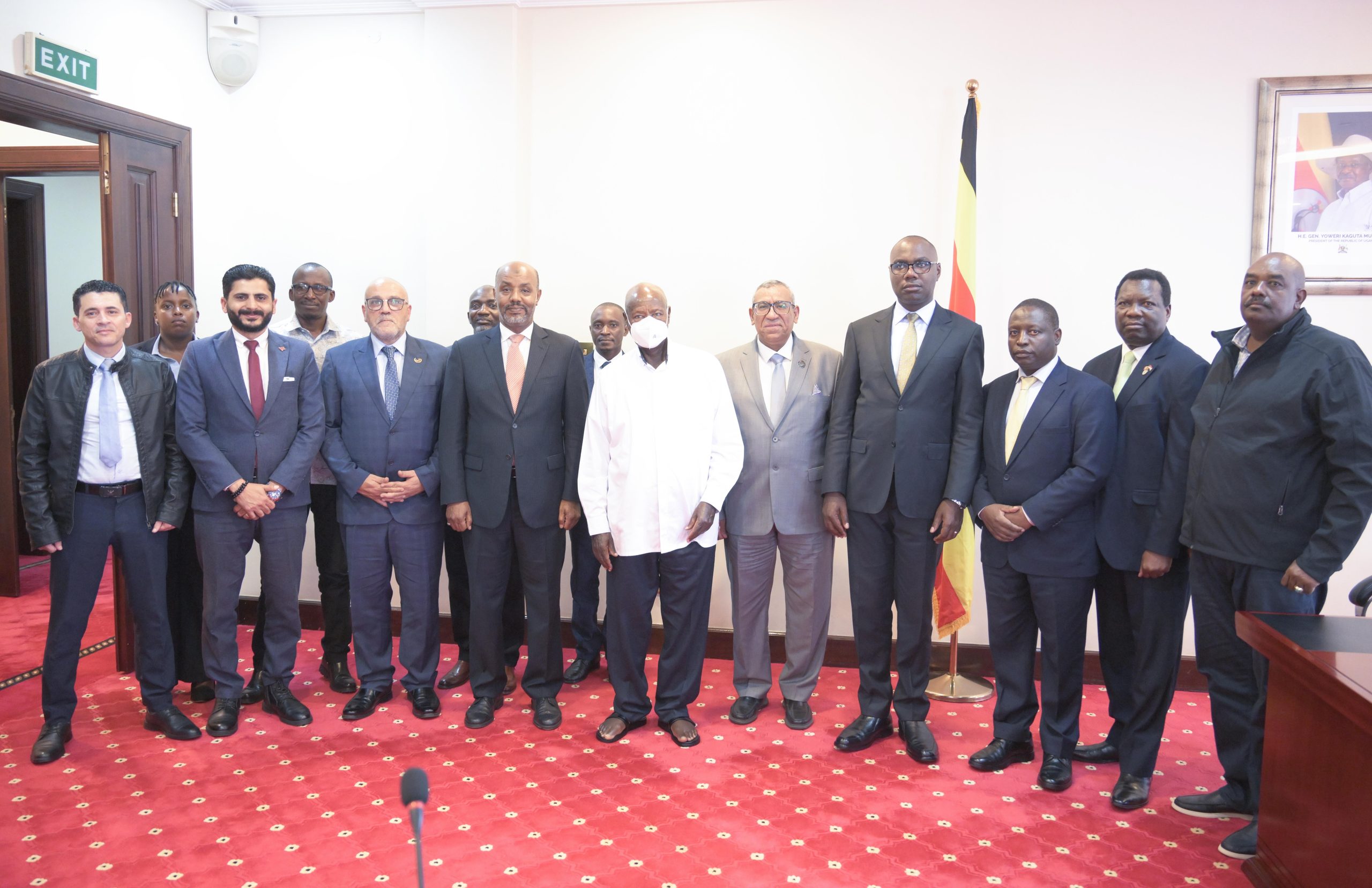
The President made the appeal today while meeting the investors at State House, Entebbe. The delegation was led by Uganda’s Deputy Ambassador to Egypt, Lt. Gen. Charles Angina.
President Museveni told the investors that Uganda produces substantial quantities of agricultural products, minerals and forest resources but needs more factories to add value to these products and affordable infrastructure to make locally manufactured goods competitive on the global market.
He noted that Uganda’s economy is anchored on four key sectors: commercial agriculture, manufacturing, services and information and communications technology (ICT), all of which require reliable and affordable infrastructure to thrive.
“The first sector is commercial agriculture. We produce a lot. That is why we want value addition. The second sector is manufacturing based on agricultural raw materials, minerals and forest products. The third sector is services and the fourth is ICT,” he said.
He identified affordable electricity as a critical requirement for industrialisation and economic competitiveness, urging investors to consider opportunities in power generation.
“We need electricity. We want an economy which produces competitive products that can compete globally. That means the price of electricity must not be too high,” President Museveni said.
He noted that electricity infrastructure could be developed by either the government or private investors with patient capital.
The President also identified railway transport as a priority, saying shifting cargo from roads to railways would lower transportation costs and improve the competitiveness of Ugandan products.
“We need the railway system. We need to transport cargo from the road to the railway because it is cheaper,” he said.
President Museveni named irrigation as another key investment area, explaining that Uganda’s reliance on rain-fed agriculture leaves farmers vulnerable to climate-related challenges.
“The third area of priority in infrastructure is irrigation because we need to stabilise agriculture,” he said.
He added that irrigation would enable farmers to produce throughout the year, supporting commercial agriculture, consistent supplies of raw materials and value addition.
The President also encouraged private investment in toll roads, explaining that such projects offer investors an opportunity to recover their investments through user charges.
“The main roads are mainly done by the government, but the private sector does the toll roads which can be used to recover the funds of the investors,” he said.
Investors propose industrial park:
President Museveni welcomed the investors’ proposal to sign a memorandum of understanding (MoU) covering one or two strategic projects, saying the government was ready to work with them.
He also endorsed a proposal to establish an industrial park housing factories to add value to coffee and cotton, pledging government support in identifying suitable land for the project.
“The idea is good. We shall identify for you an area where you can construct,” he said.
Eng. Moustafa Saad Soliman Elsayed Ahamed, an Egyptian investor in the construction sector, thanked the President for creating a stable environment for investment.
He said the delegation was interested in Uganda’s strategic infrastructure priorities, including roads, railways, water and electricity, and expressed readiness to build on the longstanding relations between the two countries.
“We are here to build on the momentum between Egypt and Uganda. We are ready to identify key strategic and priority projects that we can partner with you to make them happen,” he said.
“We assure you that we are ready to work with you and help develop Uganda’s infrastructure because this is our sister country. Africa must develop Africa, no matter what,” he added.
Other members of the Egyptian delegation who attended the meeting were Mr. Khalil Mohamed Ahmed, Dr. Sally Atef Saad Atia Bahr, Mr. Yasser Raouf Mohamed Abdallah El-Saadany, Dr. Alaa El Essawy, Mr. Mohamed El Daly and Mr. Abdulmanaeim Mohamed.