
Gen. Otafiire (L) makes a presentation before the committee as Gen Katumba Wamala looks on
By Johannah Nantongo
KAMPALA — Former Internal Affairs Minister Maj Gen Kahinda Otafiire has challenged the value of Uganda’s US$25 million Intelligent Transport Monitoring System (ITMS), arguing that the technology offered limited improvements over the police’s existing surveillance network.
Appearing before Parliament’s Committee on Physical Infrastructure on Tuesday, October 13, 2026, Otafiire said police had not been involved in procuring the system and that he had opposed its introduction because the technology was incompatible with cameras already in use.
Otafiire told the committee, chaired by Mwine Mpaka, that the system introduced from Russia did not integrate with the Chinese technology used in the existing camera network. He said he eventually came under pressure to allow the project to proceed despite his concerns.
He also questioned the equipment’s reliability, saying due diligence had indicated that it was assembled using components from different manufacturers.
Based on his experience before leaving the Internal Affairs ministry, Otafiire said the system operated more like a fleet-tracking service than the advanced transport-monitoring solution Uganda had been promised.
To demonstrate his concerns, he recounted an experiment in which number plates were removed from a vehicle and taken to his office on Jinja Road while the vehicle remained in Kololo. The system continued to show the vehicle’s location as Kololo, he said, arguing that tracking a device did not necessarily establish the vehicle’s actual location.
“So what they are selling to us is a tracking system. That is all,” Otafiire told MPs, challenging them to establish whether the US$25 million expenditure was justified.
He also questioned why authorities had opted to import number plates instead of supporting local manufacturers and creating jobs.
“If Wavamuno, who is a Ugandan was making number plates and employing our people, why did we abandon Wavamuno and others who are making number plates here to go and import number plates when they could be made here and employ our people?” he asked.
Former Works Minister Gen (Rtd) Katumba Wamala, however, offered a contrasting account, saying he had personally benefited from police surveillance and vehicle-tracking capabilities.
Katumba said police used their tracking capabilities to trace individuals suspected of involvement in the 2021 Kampala gun attack in which he was nearly killed, adding that he later saw them appear in court.
“So for me, I am a beneficiary of the system which the police is operating,” he said.
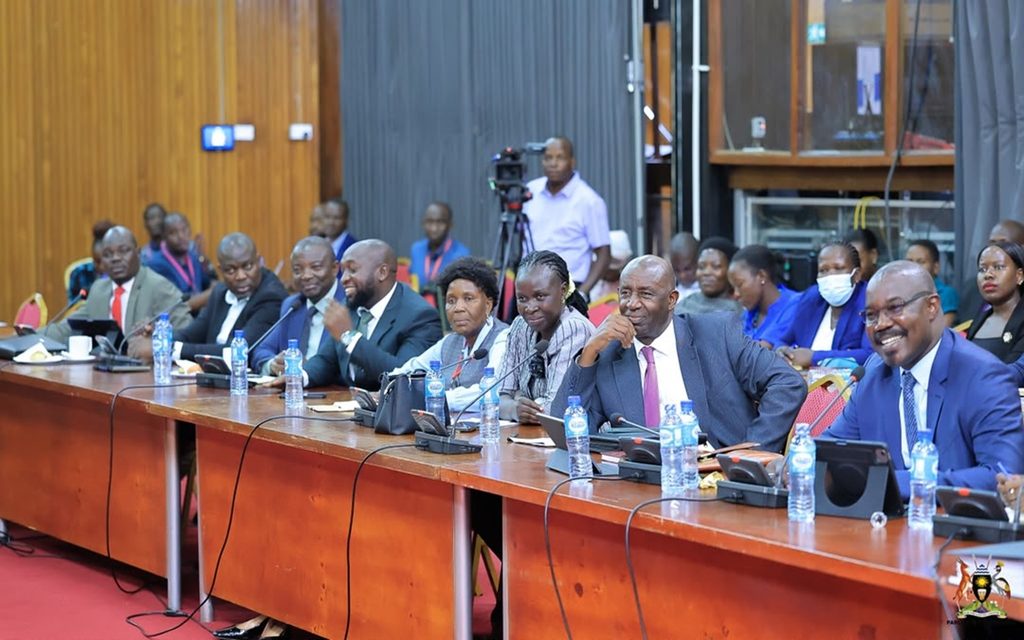
He nevertheless acknowledged that his assessment could be influenced by his personal experience as a beneficiary. He also said he could not establish whether improvements made by Global Security were linked to the technology that had helped police trace the suspects.
Otafiire insisted that the existing police camera network and the ITMS project were separate systems whose performance should be assessed independently.
“There are two systems. There is the camera system. Its problems notwithstanding, it works,” he said.
He added that two computers had been installed at the police central monitoring facility in Naguru, but even the information technology specialists he consulted could not explain their function.
Bukoto County Central MP Richard Sebamala called for scrutiny of the project’s pricing structure, questioning why existing and newly registered vehicles attracted different charges despite receiving what he described as the same package of services.
Committee Deputy Chairperson William Tiyo warned that Uganda risked wasting public money by adopting foreign technology without sufficiently evaluating its suitability and cost.
Tiyo described the original contract with Joint Stock as “a total fiasco, a total failure”, arguing that a proposed additional investment of US$158 million was intended to remedy shortcomings in the initial project.
The committee’s deliberations raise questions about the procurement process, compatibility with existing infrastructure, the cost of the system and whether the technology has delivered the benefits originally promised to the country.