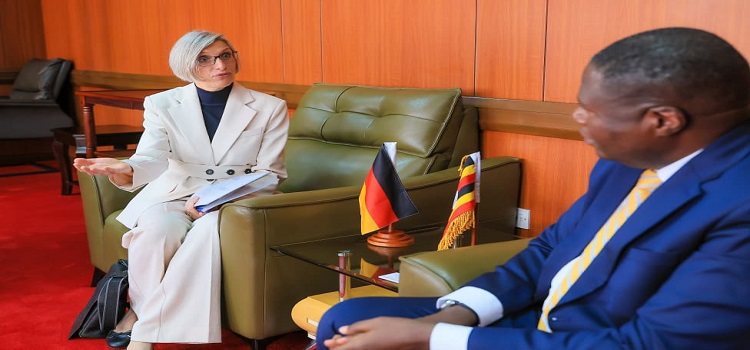
Speaker, Jacob Oboth meeting with the new German Ambassador to Uganda, H.E Sigrid Sommer (left), at Parliament Building
By Johannah Nantongo
Parliament is preparing to revive the Institute of Parliamentary Studies (IPS) as part of efforts to strengthen the skills and capacity of legislators and parliamentary staff, Speaker Jacob Marksons Oboth has said.
Oboth disclosed the plan on Tuesday, September 22, 2026, during a meeting with Germany’s new Ambassador to Uganda, Sigrid Sommer, who paid a courtesy call on him at Parliament in Kampala.
The Speaker said the revived institute would provide specialised training, research and exposure to members of Parliament and staff, with technical assistance expected from the German Parliament.
“We are restarting our Institute for Parliamentary Studies to train, expose and broaden the minds of our members and staff,” Oboth said.
The IPS was established in 2012 to provide specialised in-house training for legislators, parliamentary staff and local government officials. Its legal framework was later repealed in 2021 following the repeal of the Institute of Parliamentary Studies Act, 2020, with its functions subsequently transferred to the Corporate Planning and Strategy Department.
Under the proposed new arrangement, Oboth said the institute would become a major centre for parliamentary training, research and capacity building.
He said Uganda and Germany were also working towards a Memorandum of Understanding (MoU) that would deepen cooperation between the two legislatures.
Oboth said the partnership would enable Ugandan MPs and parliamentary staff to undertake exchange and study visits to Germany, where they would gain exposure to parliamentary procedures, institutions and practices.
He said the exchanges would also create opportunities for both countries to share experiences, adopt useful practices and strengthen parliamentary diplomacy.
“Through cooperation with the German Parliament, we will learn and unlearn, adopt best practices and strengthen parliamentary diplomacy,” Oboth said.
According to the Speaker, the planned parliamentary cooperation could also facilitate exchanges involving Ugandan legislators and, where appropriate, investors, while supporting greater engagement between the two countries on trade, human rights, humanitarian affairs and governance.
Oboth said Parliament wanted to complement the work of the Executive in promoting Uganda’s international relations and attracting investment.
“We really want to enable Parliament to complement traditional diplomacy, working alongside the head of state and government to ease bottlenecks for investors and development partners,” he said.
He stressed that parliamentary diplomacy would work alongside, rather than replace, conventional diplomatic channels.
“Parliamentary diplomacy will complement mainstream diplomacy, not compete with it,” Oboth said. “Through Parliament-to-Parliament cooperation, we can enhance trade, deepen bilateral relations and help unlock opportunities for our people.”
Ambassador Sommer welcomed the proposed revival of the institute, saying parliamentary exchanges would provide benefits to both Uganda and Germany by increasing mutual understanding.
She said German experts and facilitators would support training programmes at the institute in selected areas of parliamentary work.
Sommer also said members of a parliamentary group on Eastern Africa in the German Bundestag had planned visits focusing on humanitarian assistance and human rights. The visits, she said, were postponed following the outbreak of Ebola but are expected to be rescheduled.
The ambassador further highlighted existing scholarship and internship opportunities available to Africans, including a Ugandan participant who is expected to undertake an internship at a German institution.
The two sides agreed that the proposed MoU and revival of the IPS would provide a framework for expanding parliamentary cooperation, professional development and institutional learning between Uganda and Germany.