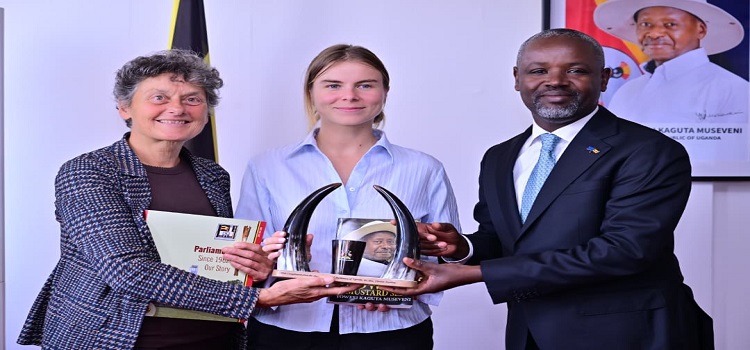
Deputy Speaker Tayebwa (right) exchanges gifts with Members of the European Parliament, Hon. Tineke Strik and Hon. Anna Strolenberg.
By Joseph Kiggundu
Deputy Speaker of Parliament Thomas Tayebwa has appealed to the European Union to increase funding for Uganda’s refugee response, warning that declining humanitarian assistance is putting growing pressure on public services and communities hosting more than two million refugees and asylum-seekers.
Tayebwa made the call on Monday, September 21, 2026, while meeting Members of the European Parliament, Tineke Strik and Anna Strolenberg, at Parliament in Kampala.
The delegation was in Uganda to learn about the country’s refugee policies and explore ways of strengthening cooperation between Uganda and the EU on refugee management.
Tayebwa said Uganda’s 2026 refugee response plan requires about $850 million, but international partners had provided only 12 per cent of the required funding at the time of the meeting.
He said the funding shortfall was affecting services for both refugees and Ugandan communities hosting them, particularly in the health and education sectors.
“All this is happening at a time when there is a decline in funding,” Tayebwa said, adding that reduced donor support had affected the number of teachers and health workers previously supported through humanitarian programmes.
He said the shortage was also putting pressure on the Department of Refugees under the Office of the Prime Minister.
“From our assessment, the current humanitarian funding model is no longer sufficient. Without alternative financing, pressure will overwhelm the government and host communities,” Tayebwa said.
Despite the funding constraints, Tayebwa said Uganda would continue receiving people fleeing conflict, describing the country’s refugee policy as rooted in humanitarian principles.
“These people are helpless; they are vulnerable. We struggle to provide for these refugees, but we are not struggling with the spirit of humanity to welcome them,” he said.
Uganda hosts more than two million refugees and asylum-seekers, with the largest populations originating from South Sudan and the Democratic Republic of Congo. The European Commission currently puts Uganda’s refugee and asylum-seeker population at about two million, with women and children accounting for 77 per cent.
Tayebwa also urged the EU to support efforts to address the conflicts driving displacement, saying humanitarian assistance alone would not resolve the refugee crisis.
He warned that refugees without adequate support and opportunities to rebuild their lives could become vulnerable to trafficking, exploitation and recruitment by armed groups.
“If Uganda cannot help these people settle, they are the people who will join Al-Shabaab, these are the people who will be trafficked to Europe,” Tayebwa said.
Tayebwa said the refugee crisis could also provide an opportunity for Uganda, Africa and Europe to strengthen their cooperation at a time of uncertainty in global affairs.
“At the time when multilateralism is dying and the global political arena is unpredictable, this is the time for Africa and Europe to strengthen their relationship,” he said.
He thanked the EU for its contribution to Uganda’s refugee response, describing the bloc as a dependable partner.
The EU has allocated €20.7 million in humanitarian assistance to Uganda in 2026, compared with €23.9 million in 2025, and says it has provided more than €194 million in humanitarian funding to Uganda since 2021.
Speaking during the meeting, Strik acknowledged Uganda’s role in hosting refugees and said European countries could learn from the country’s approach to receiving people fleeing conflict.
“The EU and also the Netherlands can take Uganda as an example of hospitality,” Strik said.
She also acknowledged the funding challenges facing refugee-hosting countries and called for continued international support.
“I think we also need to address the issue of funding. International partners should not leave Uganda alone,” she said.
?>