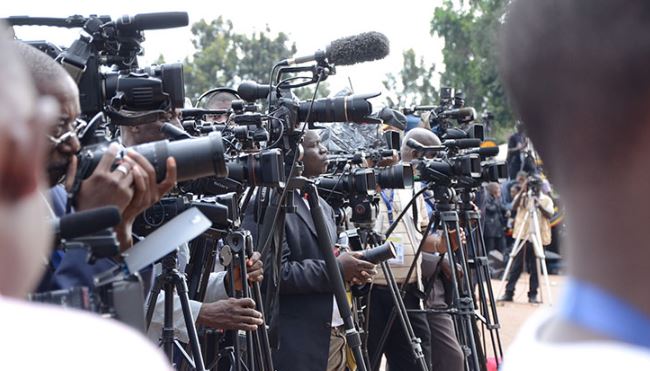
Uganda’s media industry has mounted one of its strongest collective objections in recent years – against the Protection of Sovereignty Bill, 2026 – warning that the proposed law risks turning everyday journalism into a criminal offence and placing broadcasters, advertisers and content producers in legal jeopardy for doing their normal work.
In a detailed submission to Parliament, the National Association of Broadcasters (NAB) describes the Bill as “draconian, unconstitutional, and economically suicidal,” with its Chief Executive Joseph Beyanga telling the Clerk to Parliament in a submission that while the State’s concern for sovereignty is legitimate, the draft law goes far beyond regulation and ventures into criminalising constitutionally protected expression.
At the centre of the backlash are Clause 10 and Clause 13—two provisions NAB says effectively redefine journalism itself as a potential national security threat.
Clause 10, which prohibits activities involving foreign assistance in promoting “foreign policy not adopted by Cabinet,” has been singled out as a direct threat to media operations
According to NAB, the clause would capture routine newsroom work and commercial broadcasting arrangements that define the industry.
“By its very nature, the media business involves promoting the activities, events, and viewpoints of its clients and sponsors including foreign embassies, international government agencies, and multilateral organizations. This is lawful, legitimate commercial activity,” the association argues.
The broadcasters warn that under the Bill’s wording, even covering or advertising diplomatic events could become criminal exposure.
They cite examples of embassies hosting national day celebrations, policy launches, and development partner workshops, all of which are routinely publicised by media houses under paid arrangements.
“If that report contains policy recommendations not yet ‘adopted by Cabinet’… the media outlet has technically ‘promoted foreign policy’ without Cabinet approval,” NAB warns, adding that this creates a legal trap where journalists cannot reasonably determine what is lawful before publication.
The association further criticises the absence of a clear definition of “foreign policy” in the Bill, describing it as “infinitely elastic,” and therefore open to arbitrary enforcement.
“This violates the constitutional principle that a penal law must be sufficiently certain,” NAB states, warning that the provision would create a chilling effect where media houses self-censor to avoid prosecution.
But it is Clause 13 that has drawn even sharper concern.
The clause criminalises publishing any information or participating in activities that “weaken or damage the economic system or viability of the country,” with penalties of up to 20 years in prison.
NAB says this provision effectively converts economic reporting and political commentary into potential offences.
“In any democratic society, the media has a constitutionally protected duty to criticise government policy, scrutinise economic management, and hold public officials accountable. This is not sabotage; it is the lifeblood of democracy,” the submission reads.
The association warns that reporting on inflation, debt levels, corruption in public enterprises, or even broadcasting opposition criticism of economic policy could be interpreted as “economic sabotage.”
“Is any negative economic report sabotage? If a journalist accurately states that the shilling has fallen against the dollar, is that ‘damaging viability’?” NAB questions.
The submission also highlights the absence of intent in Clause 13, arguing that even factual reporting could attract prosecution if it is deemed to have caused “instability.”
“A well-researched, factual report that inadvertently causes a dip in the stock market could lead to a 20-year prison sentence,” the broadcasters caution.
NAB further invokes Uganda’s own constitutional jurisprudence, including the Supreme Court ruling in Charles Onyango Obbo & Andrew Mwenda v Attorney General, which emphasised that restrictions on expression must meet tests of legality, necessity and proportionality.
Beyond legal concerns, NAB warns of broader economic consequences, arguing that the Bill would discourage foreign partnerships, damage investor confidence, and undermine Uganda’s creative and services economy.
The Uganda Bankers Association has raised parallel concerns, warning that provisions on foreign funding thresholds and forfeiture risks could destabilise financial systems and deter investment.
NAB also argues that the Bill is redundant, pointing to existing legal frameworks such as the Anti-Money Laundering Act, the Financial Intelligence Authority mandate, the NGO Act, and the Public Finance Management Act, which already regulate foreign financial flows.
“The mischief it purports to address is already covered by existing Ugandan law,” the association states.
At the heart of NAB’s opposition is a constitutional argument: that the Bill violates Article 29 on freedom of expression and press freedom, and creates what it calls “a chilling effect” on journalism.
It concludes that Clause 10 should be deleted entirely, while Clause 13 is described as an “existential threat” that must also be scrapped.
“The media is directly threatened,” NAB warns. “Uganda’s sovereignty belongs to the people. This Bill attempts to abolish it.”
Across the country, the Bill has sparked growing resistance from media houses, civil society organisations, bankers and legal experts, who argue that its language is too broad, its penalties too severe, and its implications too far-reaching for a democratic society.
As Parliament considers the draft law, the central question remains whether a statute intended to protect sovereignty could instead redefine criticism, journalism and international engagement as crimes against the state.