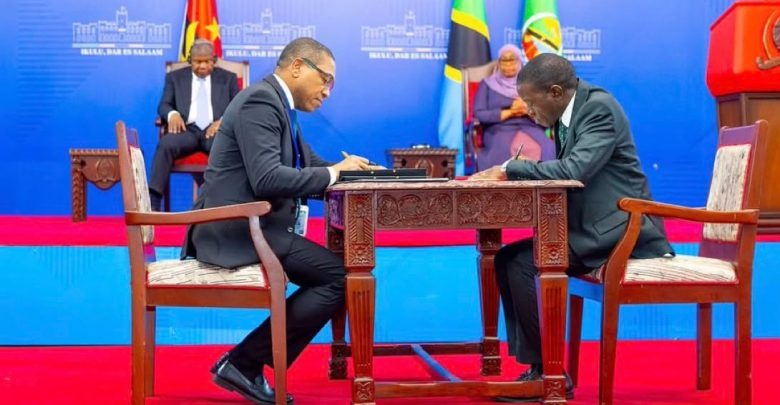
Tanzania and Angola have agreed to connect their railway networks through Zambia and the Democratic Republic of Congo (DRC).
This will be achieved by establishing a proposed trans-African transport corridor linking the Indian and Atlantic Oceans to boost regional trade and mineral exports.
The agreement followed talks between Zambiaand her Angolan counterpart, João Lourenço, during his state visit to Tanzania on October 29–30, 2026.
Under the plan, Tanzania’s Dar es Salaam port will be connected to Angola’s Lobito port by linking the Tanzania-Zambia Railway Authority (TAZARA) network with Angola’s Benguela Railway.
The project would provide an alternative route for transporting copper, cobalt, agricultural products and other goods between eastern, central and southern Africa.
“We are committed to doing everything possible to ensure the success of this major project linking the Benguela Railway to TAZARA,” Lourenço said, according to an English translation of his remarks.
The initiative comes amid growing investment by China and Western powers in Africa’s strategic transport infrastructure.
In 2025, China signed a $1.4 billion agreement to modernise TAZARA, while the United States and European Union are supporting the Lobito Corridor, which connects Angola’s Atlantic coast to mineral-producing regions in the DRC and Zambia.
Connecting the two networks would potentially provide exporters with access to ports on both sides of Africa, although additional construction and financing will be required.
Lourenço urged African countries to prioritise economic cooperation among themselves rather than relying excessively on partnerships outside the continent.
“Sometimes our countries establish these same cooperation relationships with distant countries in Europe, America and Asia, and leave our own African brothers in second place,” he said.
The two governments also signed four bilateral agreements covering the transfer of sentenced persons, air transport, information and communication technologies, and metrology.
Angola further invited Tanzania to invest in its Lobito oil refinery, with the Tanzania Petroleum Development Corporation assessing the proposal.
Meanwhile, Hassan and Lourenço inaugurated government ministry and institutional office buildings, alongside tarmac roads, at Mtumba Government City in Dodoma.
Hassan said the development advanced Tanzania’s longstanding commitment to relocate its capital to Dodoma, following a resolution adopted by the Tanganyika African National Union (TANU) on September 24, 1973.
“Since then, every administration has carried forward that resolution,” she said, crediting previous presidents with advancing founding President Julius Nyerere’s vision.
She said the government city, financed through domestic resources, was intended to strengthen public administration, diplomacy and economic activities, but cautioned against centralising essential services in Dodoma.
“Services should reach citizens wherever they are through information and communication technology systems, rather than forcing them to travel to Dodoma to access them,” Hassan said.
She directed authorities to maintain the new infrastructure, enforce Dodoma’s 2019–2039 development master plan, strengthen social services and attract private investment.
Lourenço’s visit, the first state visit by an Angolan president to Tanzania in 47 years, also highlighted historical ties dating back to Tanzania’s support for Angola’s liberation struggle.
The proposed railway connection represents an effort to translate those longstanding relations into infrastructure and trade cooperation, although its implementation timeline and overall cost remain undetermined.