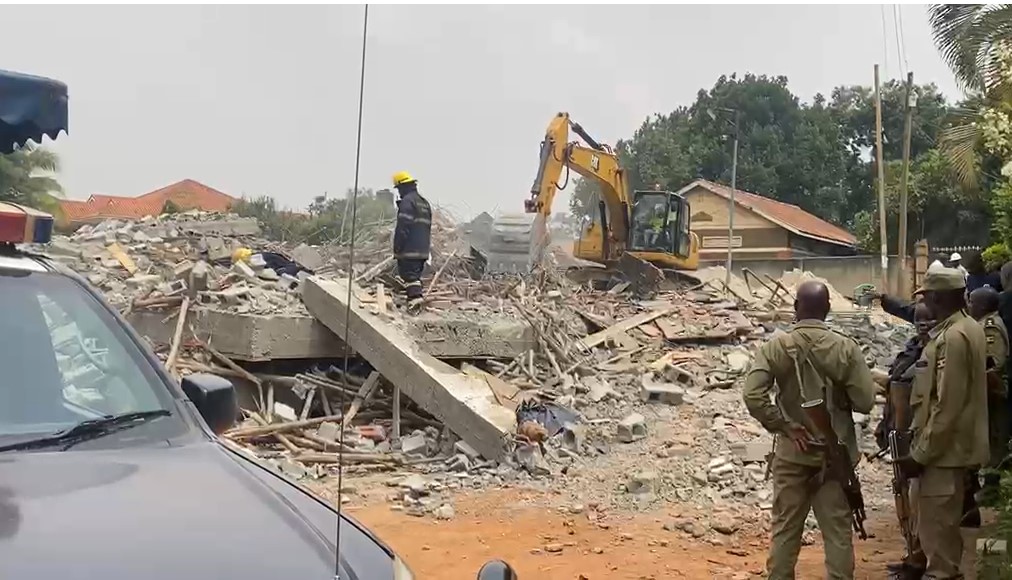
KAMPALA. Three people have been confirmed to have died in a collapsing building in Kisota Zone, Kikaya Parish, Kisasi, Kawempe Division ,Kampala District on Friday afternoon .
By Saturday evening, nine survivors had been rescued and hospitalized hopes of finding other survivors are fading .
Kampala Metropolitan Police spokesperson, Rachel Kawala, confirmed that two of the deceased have been identified as Jonathan Kivumbi and James, popularly known as “Rasta.” The identity of the third adult male remains unknown. Their bodies have been transported to Mulago City mortuary for postmortem examinations.
The three-storey structure, which had been under construction for approximately eight months, suddenly caved in from the top floor at around 1:00 PM on Friday, trapping several casual laborers beneath a mass of concrete bricks and twisted iron bars.
As the Police Fire and Rescue Services, alongside the Uganda Red Cross, continue search operations, the spotlight has firmly shifted to regulatory negligence and poor enforcement by local authorities.
The Kampala Capital City Authority (KCCA) Executive Director, Sharifa Buzeki, revealed that the structure was completely illegal.
“The building was being constructed illegally because its plans had not been approved,” Ms Buzeki said. “The developers were issued a stop notice in April, but they defied it and continued with construction, mostly operating at night to evade enforcement officers.”
Engineer Justus Akankwasa, the KCCA Director of Engineering and Technical Services, attributed the disaster to a catastrophic mix of poor structural design and the deployment of substandard materials.
Police have launched a manhunt for the culprits behind the site. “We are tracking down the site owner and the site engineer,” Ms. Kawala stated, noting that criminal investigations regarding negligence have commenced. “They must present their KCCA approved plans and professional qualifications.”
The disaster has reignited a fierce public debate regarding KCCA’s oversight and supervision capabilities. Kawempe Division Mayor, Emmanuel Sserunjogi, acknowledged the enforcement crisis, pointing out that KCCA’s physical planning and engineering departments are crippled by severe administrative challenges, including a lack of substantive leadership and staffing gaps that make routine field inspections nearly impossible.
This collapse adds to a grim trajectory of structural failures across the capital. National Building Review Board (NBRB) data indicates that Uganda registered at least 41 structural failures between 2019 and 2025, resulting in more than 90 fatalities. High-profile incidents—such as the 2020 Lukuli-Makindye collapse that claimed 13 lives—were similarly blamed on unqualified contractors and a total absence of routine KCCA field oversight.
The tragedy occurs just two months after the enactment of the Building Control (Amendment) Act 2026, which raised penalties for non-compliance to 12 years in prison. Yet, critics argue that until KCCA enforces rigorous, proactive on-site supervision rather than reactive post-disaster statements, Kampala’s booming construction sector will remain a death trap.