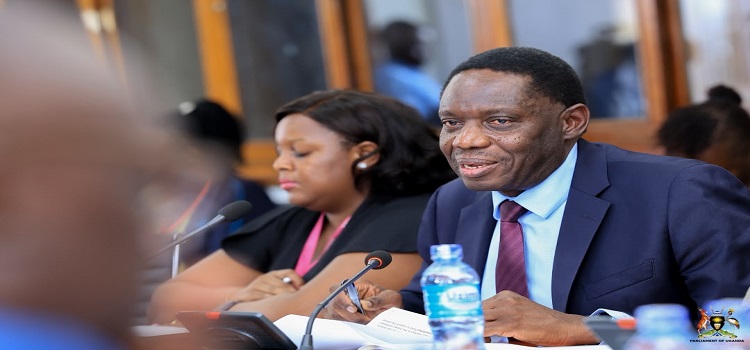
Bank of Uganda Governor, Michael Atingi-Ego, appearing before the House Committee on the Budget on Monday, 21 September 2026
By Joseph Kiggundu
KAMPALA — Bank of Uganda Governor Michael Atingi-Ego has warned that excessive government borrowing from the domestic market could push up interest rates and restrict private-sector access to credit.
Atingi-Ego said the domestic financial market currently has sufficient capacity to absorb the government’s planned borrowing, but cautioned that borrowing beyond the projected levels could reverse recent gains in the financial sector.
The Governor was appearing before Parliament’s Budget Committee, chaired by Gabriel Okumu, on Monday to give the central bank’s assessment of the Charter of Fiscal Responsibility, which sets out principles and targets for managing public finances.
Atingi-Ego described the Charter as “broadly credible”, provided government maintains fiscal discipline, manages petroleum revenues prudently and keeps domestic borrowing within the projected limits.
For the 2026/27 financial year, the Charter projects net domestic financing of about Shs12.7 trillion, equivalent to 4.6 per cent of non-oil GDP. This is lower than the Shs15.1 trillion financed domestically in the previous financial year.
“The market has what it takes to absorb this proposed net domestic financing,” Atingi-Ego told MPs, citing improved liquidity in the banking system, lower yields on government securities and continued investor demand for Treasury securities.
He, however, warned that government could crowd out private borrowers if it exceeds the planned borrowing levels.
“The risks are that government may be tempted to go for higher than projected domestic borrowing, and it could reverse the gains by placing upward pressure on the interest rates and therefore crowding out the private sector,” he said.
Private-sector credit grows
Atingi-Ego said private-sector credit grew by 16.1 per cent year-on-year to June 2026, while average monthly growth during the financial year stood at about 11.5 per cent.
He projected average private-sector credit growth of about 13 per cent in 2026/27, provided fiscal and monetary conditions remain supportive.
The Governor said interest rates could continue declining gradually if government maintains fiscal consolidation and adheres to the assumptions contained in the Charter.
He also warned that significant changes in government expenditure or taxation could increase inflationary and financial-market pressures.
“If there are any deviations in the fiscal path that will compromise price stability, we will take all the appropriate actions to ensure that price stability is maintained,” he said, adding that this could include raising interest rates.
Oil revenues
On petroleum revenues, Atingi-Ego clarified that the Petroleum Revenue Investment Reserve remains an asset of government, although the Bank of Uganda manages it operationally.
“These will be government assets. They will not be Bank of Uganda balance sheet,” he said.
He explained that petroleum revenues invested outside Uganda would not immediately inject liquidity into the domestic economy. The impact on local liquidity would mainly arise when the funds are transferred to the Consolidated Fund and subsequently spent within the country.
Meanwhile, committee chair Gabriel Okumu urged Parliament’s Finance, Budget and National Economy committees to intensify scrutiny of government borrowing.
“If we are not careful, especially the committees on Finance, Budget and National Economy, if we do not put our foot down, we are really going to let the country down,” Okumu said.
He urged the committees to use the next five years to closely monitor government borrowing and advise on its sustainability.
Bukoto County Central MP Richard Sebamala (DP) questioned whether government could maintain its expenditure programme while servicing debt, stabilising the exchange rate and dealing with possible delays in expected oil revenues.
He also asked whether Parliament should amend the fiscal rules if government fails to meet its projected oil revenue timelines.
Atingi-Ego said the central bank remained assured about the oil revenue projections.
Jonam County MP Marshall Alenyo also questioned whether the Charter should contain specific reporting requirements on domestic arrears, warning that expenditure controls could potentially be undermined through accumulation of unpaid government bills.