By Jazeerah Mirembe
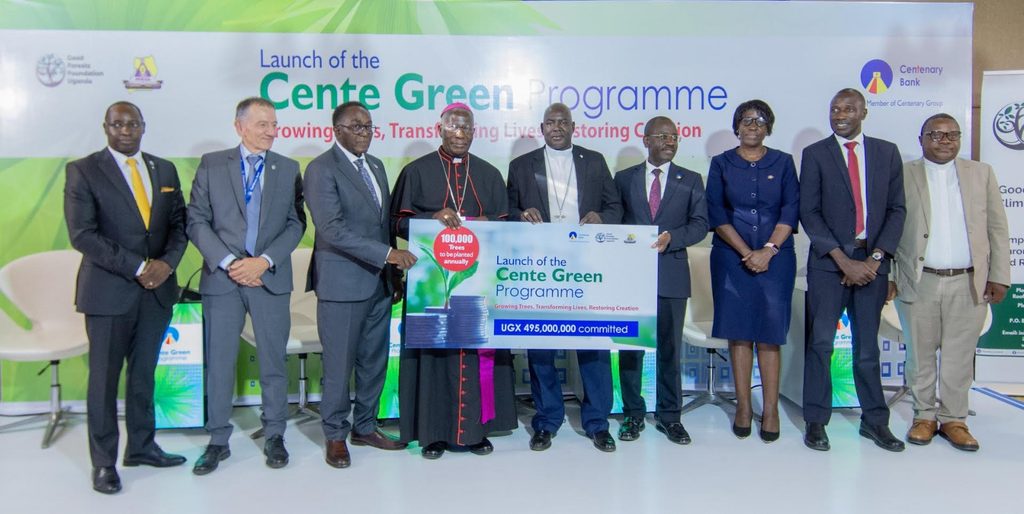
Centenary Bank has launched Cente Green Days, a five-year tree-growing and landscape restoration initiative that will support the planting of 500,000 indigenous timber and fruit trees across Uganda.
The initiative, launched under the theme “Growing Trees, Transforming Lives, Restoring Creation,” is aimed at restoring degraded landscapes while creating environmental and economic benefits for participating communities.
Environmental degradation, particularly deforestation, remains a major sustainability challenge and contributes to climate change and global warming. It affects agricultural production, business continuity, household incomes and the wellbeing of communities through irregular rainfall patterns, prolonged droughts, floods and other climate-related impacts.
Speaking at the launch, Centenary Bank Managing Director Godfrey Byekwaso said Cente Green Days forms part of the bank’s Environmental, Social and Governance (ESG) agenda and its commitment to sustainable and responsible banking.
“At Centenary Bank, we are a values-based bank that recognises the critical connection between financial services, businesses, communities and the environment in which they operate. It is therefore imperative for us to restore the environment in order to enhance the resilience and prosperity of communities, especially vulnerable ones. Only then can the bank prosper,” he said.
Centenary Bank plans to support the planting of 100,000 indigenous timber and fruit trees annually for the next five years across Uganda, bringing the total to 500,000 trees by 2030.
The initiative is expected to contribute to the restoration of approximately 300 acres of degraded land across 12 districts this year and about 1,500 acres over the five-year period.
The bank is implementing the initiative in partnership with the Uganda Episcopal Conference and Good Forests Foundation, with 12 dioceses — Arua, Nebbi, Kiyinda-Mityana, Jinja, Masaka, Mbarara, Kabale, Kasese, Kotido, Moroto, Fort Portal and Tororo — already participating in the programme.
Byekwaso said the bank chose to work with the Catholic Church because of its trusted leadership, strong community presence and long-standing commitment to environmental stewardship.
He noted that the Church owns significant amounts of degraded land and has the capacity to mobilise communities and inspire people to embrace environmental conservation as a shared responsibility.
Good Forests Foundation, he added, brings technical expertise required to deliver lasting results. Its knowledge in site assessment, species selection, planting, maintenance and monitoring will support tree survival and the successful restoration of degraded land.
“We also want participating communities to receive practical benefits from this programme. Indigenous timber and fruit trees can help protect soils, improve food security, diversify household incomes and strengthen resilience to erosion, floods and droughts,” Byekwaso added.
He called on other organisations to join Cente Green Days and contribute resources, expertise and community networks to expand the programme’s impact beyond its initial five-year target.
Tree growing is not new to Centenary Bank. Since 2023, the bank has supported the planting of more than 250,000 trees across the country.
In 2025, the bank also began measuring its carbon emissions, which stood at more than 6,000 tonnes of carbon dioxide equivalent.
The bank is now taking deliberate steps to manage and reduce its environmental footprint, including supporting tree growing as part of broader efforts to contribute to carbon sequestration.