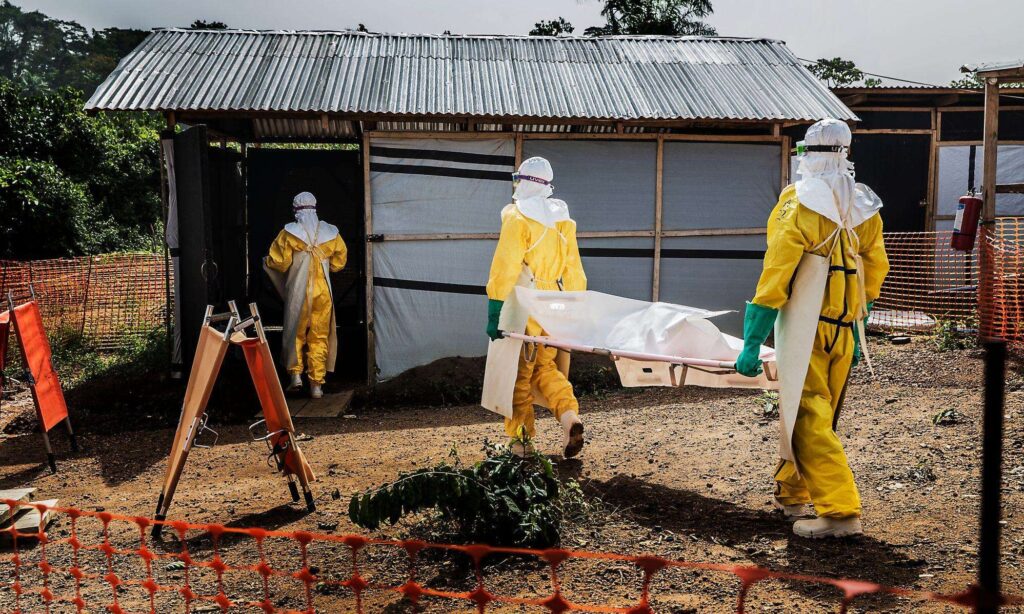
KAMPALA.Ugandan health authorities have said they are on high alert after a fresh Ebola outbreak was reported in the Democratic Republic of Congo (DRC).
Four deaths have so far been confirmed .
According to the Africa Centres for Disease Control and Prevention, 13 Ebola cases have so far been laboratory confirmed in the neighbouring DRC, with about 65 suspected deaths reported in the Mongwalu and Rwampara health zones.
Authorities are also investigating another 246 suspected cases, while additional samples from Bunia are still undergoing laboratory analysis.
The Africa CDC says preliminary findings suggest the outbreak may involve a non-Zaire strain of the Ebola virus, with genomic sequencing expected to confirm the exact strain within hours.
The outbreak has heightened concern across the region because of the proximity of the affected areas to Uganda and South Sudan, coupled with intense population movement linked to mining activities and trade.
Ugandan health authorities saif on May 15, that the country’s surveillance and emergency response systems remain on high alert amid fears of possible cross-border transmission.
Uganda’s Health Minister, Jane Ruth Aceng, says the country has over the years invested heavily in systems designed to quickly detect and respond to outbreaks before they escalate.
“The systems start from the grassroots and move up to the central region,” Dr Aceng said.
“At the grassroots level we have our community health extension workers and the VHTs who have been trained not only to offer services door to door but also to act as surveillance officers.”
She explained that the Village Health Teams monitor communities for unusual illnesses and report suspicious cases through an electronic reporting platform known as the Community Health Information System.
“This information is relayed directly to our emergency operation centres that are in every region of the country — that makes it 18 regions. So we pick up this information and we are able to respond in real time. And that is our strength of responding to outbreaks,” she said.
Dr Aceng noted that Uganda’s geographical location within the Congo Basin makes the country naturally vulnerable to recurrent outbreaks of viral haemorrhagic fevers such as Ebola.
“When we got our first outbreak in the year 2000 in Gulu, Uganda was quite green about these outbreaks. But since then we have built systems,” she said.
According to the minister, Uganda’s preparedness was strengthened with support from the United States Centers for Disease Control and Prevention through pilot programmes aimed at improving laboratory capacity, disease surveillance and rapid response mechanisms.
“We set out to build systems for detection. We put up a laboratory system that is spread all over the country and we call them hubs,” she said.
The minister added that Uganda has also invested in mobile laboratory sample collection systems and training epidemiologists under the Field Epidemiology Training Programme to improve real-time outbreak investigations and response.
“We also set up the Emergency Operations Centres where we have dashboards. If I turn them on, I am able to view all the districts in Uganda at any one time,” Dr Aceng said.
Uganda’s latest Ebola outbreak was declared over in April 2025 after lasting less than three months. The outbreak, confirmed in Kampala, registered 14 cases, including 12 confirmed and two probable infections. Four people died while 10 recovered.
Since 2000, Uganda has successfully contained six Ebola outbreaks, five of them caused by the Sudan strain of the virus.
Health experts say Ebola Virus Disease spreads through direct contact with bodily fluids of infected persons, contaminated materials and infected bodies, warning that early detection, isolation, contact tracing and safe burials remain critical in stopping transmission.