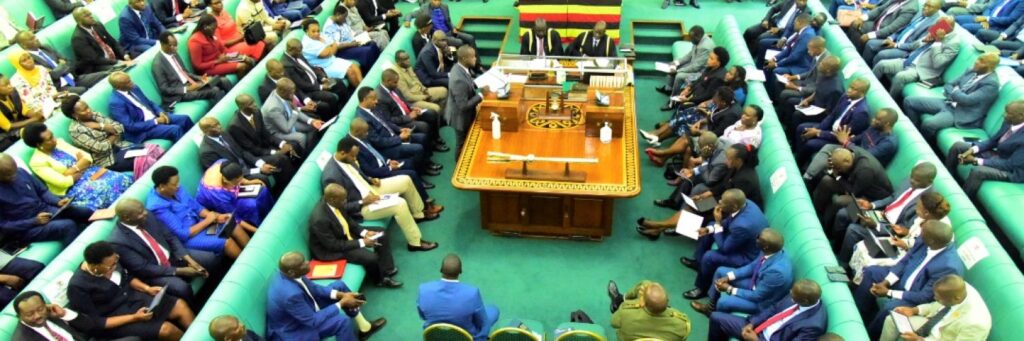
The House sitting that on Tuesday, May 5,2026 despite stiff resistance from Opposition legislators processed and passed the controversial Protection of Sovereignty Bill, 2026.
On several occasions during Plenary , the opposition camp led by the Nakawa West legislator, Mr Joel Besekezi Ssenyonyi, had a string of its attempts raised on technical and procedural terms either ‘ignored’ or fetched no conclusive redress.
The free-sitting declared by the House Speaker, Anita Among, attracted regular absentee Ministers who, together with other habitual absentee MPs, filled the House to full capacity. This also compelled National Resistance Movement (NRM), MPs and government Ministers to throng the opposition side-something that left many MPs that came late to stand throughout the heated House sitting.
Attempts to block Bill foiled
Minutes before the State Minister for Internal Affairs, Gen. David Muhoozi, could kick-start deliberations on the controversial Bill, the Leader of Opposition (LoP), attempted to have the Bill thrown out. Mr Ssenyonyi had based his call on two grounds.
He told Parliament that the Bill that was about to be handled was fresh and different from the one that same House had received late last month. Mr Ssenyonyi argued that the same Bill was about to be processed premising on a leaked committee report and yet the same 11th Parliament had blocked the tabling of the Uganda Airlines probe report that was authored by the Committee on Commissions, Statutory Authorities and State Enterprises, COSASE, on the same ground.
In response, Speaker Among disclosed that the Protection of Sovereignty Bill report had been authenticated as opposed to the one authored on Uganda Airlines over two years ago.
“This report that was uploaded had my signature. I even said ‘please place it on the order paper with my very able signature’,” Ms. Among told Ssenyonyi.
She added, “The report of Airlines that got out did not have my signature. I am the only one who can sanction documents to be uploaded which I did. So, the [Protection of Sovereignty Committee] report was not leaked out.”
This consequently paved the way for Mr Wilson Kajwengye, the co-chairperson of the joint committees of Defense and Internal Affairs, and that of Legal and Parliamentary Affairs, to present the majority report. His presentation was arguably uninterrupted.
Opposition gagged?
A regrettable scene played out when Ms Anita Among directed that all six minority reports be presented within 35 minutes, reasoning that the same time had been used by Mr Kajwengye to read out the majority report that endorsed the passing of the said Bill.
This triggered uproar and was strongly rejected by the opposition. For instance, the Shadow Constitutional Affairs Minister, Jonathan Odur, openly declined to heed the instruction to split their 35 minutes with his other five colleagues who authored dissenting reports.
“When a member of the committee dissents singularly, the weight of the report demands that we will be accorded the same time,” Mr. Odur said, but Speaker Among insisted, something that Mr. Odur refused to heed.
However, this was only part of the several obstacles that awaited the opposition.
Mr Odur used part of his report to capture what he termed as ‘incompetence’ of the co-chairpersons of the joint committee, which he alleged had been witnessed throughout the period of authoring the Bill.
“The co-chairpersons exhibited gross incompetence, lack of tolerance for divergent views and stifled all avenues of debate during consideration of the Bill,” Mr Odur reported to Parliament.
This seemed to have pained Speaker Among who reacted saying, “By the time you come and be a Member of Parliament in this House, [then you are competent]. Let’s tone down our language. Let it be Parliamentary…These gentlemen are competent.”
Again, Mr Odur declined to revise his position, something Ms. Among instructed the Hansard team to expunge off the House record.
Much as his counterpart Mr Kajwengye read his report to completion, Mr Odur had his presentation cut halfway when Ms. Among instructed him to condense contents on more than 20 pages into a five-minute submission. This was objected to by the Erute South outgoing legislator.
“In the joint committee, I was not given the opportunity. For that, let me put it on record that the five minutes you have given to me is not enough for me to finish,” Mr. Odur said.[reason]
This was suffered by other authors of minority reports, something that saw Shadow Attorney General Mr. Wilfred Niwagaba plead for space on the floor.
“I believe you will give me my right as a member who prepared a report which was co-signed by two other members; Hon. Ann Adeke Ebaju and Hon. Asuman Basalirwa,” he begged to be allowed time to present his report.
In the end, he was only accorded five minutes. The other minority reports were authored by Mr. Gilbert Olanya, Kilak South, Mr. Abdallah Kiwanuka, Mukono North, Mr. Médard Sseggona, Busiro East, and Ms. Betty Nambooze, Mukono Municipality.
This was strongly condemned by Ms. Nambooze, who also doubles as the Shadow Internal Affairs Minister.
“My request is that the 11th Parliament stops behaving as if it is the last Parliament Uganda will ever have. There will be other Parliaments that will come after this Parliament,” Ms. Nambooze urged Parliament.
She went on to buttress the fears Mr. Odur had earlier raised, stating that opposition members had not been accommodated during internal proceedings when the joint committee processed and later authored the report at the Speke Resort Hotel Munyonyo.
“You have been told that 57 memoranda were reviewed ,but the fact of the matter is that the committee received over 700 memoranda, one of them being from the Buganda Kingdom,” Ms. Nambooze said.
Whereas the majority report was largely heard in silence, the opposition severally faced interruptions from the NRM side, as some of the members of the government side openly indicated that the ‘loud laughter’ and ‘noise’ made it hard for the opposition side to be heard.