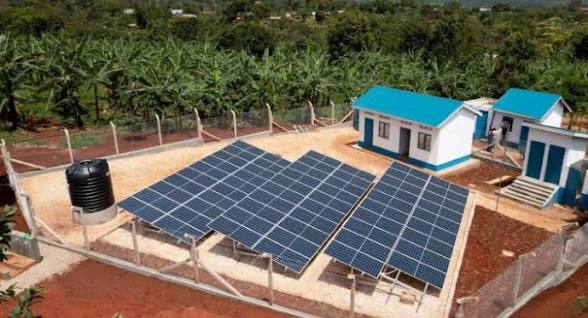
Parliament has approved a loan request allowing government to borrow up to Euro 168,976,354, approximately Shs734.2 billion, for the development of Phase II of the solar-powered irrigation systems project.
Finance Minister Henry Musasizi tabled the motion to borrow the money from UK Export Finance and Citi Bank during the fourth sitting of the 12th Parliament, presided over by Speaker Marksons Jacob Oboth-Oboth.
According to him, the proposed project will develop 427 irrigation systems across the country, aimed at enhancing rural incomes through increased production and productivity arising from irrigated agriculture for coffee growing.
He said the project is expected to directly benefit about 2,562 households, translating to about 11,785 direct beneficiaries.
The Finance Minister disclosed that the loan proposal is to finance the budget for FY 2026/2027, which starts on 1st July.
Meanwhile, Leader of Opposition Joel Ssenyonyi emphasised the need for accountability on the money extended in phase I of the project.
Katikamu South MP Hassan Kirumira told the House that the irrigation project government is borrowing for is one of the worst-performing projects. “In phase I, many projects were incomplete, and as we speak now, it is redundant with no productivity,” he said.
According to the motion, President Yoweri Museveni cleared the project for implementation in his letter dated 15th December 2021 under reference number PO/IO addressed to the Minister of Finance, Planning and Economic Development and the Ministry of Water and Environment.
The Finance Ministry says that to date, Phase 1 of the project has achieved over 99 physical completion with 434 systems developed across the country, delivering verifiable economic benefits countrywide. These include 148 Rural Water Supply Systems benefiting 98,521 households and 433,492 individuals; 83 Urban Water Supply Systems serving 107,390 households and 472,519 people; and 203 Irrigation Systems irrigating 2,000 acres while supporting 554 households and 2,436 residents.
It adds that collectively, the initiatives have enhanced water security and productivity for 206,465 households and a total population of 908,447 across Uganda.
Uganda’s loan and current debt situation
As at end December 2025, Uganda’s total debt stock amounted to USD34.86 billion, equivalent to 52.7 per cent of GDP, according to statistics from the Ministry of Finance, Planning and Economic Development.
The ministry explains that, in line with the Debt Sustainability Analysis Report of December 2025, which reports debt statistics on a Financial Year basis, Uganda’s debt remains within sustainable limits, with the total stock at USD32.24 billion, approximately Shs116 trillion, for FY 2024/25.
This comprises USD15.46 billion, Shs55.6 trillion, in external debt and USD16.79 billion, Shs60.35 trillion, in domestic debt.
Public Debt as a share of GDP is estimated at 50.86 per cent, aligning with the targets set in the Charter for Fiscal Responsibility.
It adds that the current project is already included in the Debt Sustainability Analysis and in the Fiscal Framework for the Budget for FY 2026/27 and the medium-term fiscal framework, noting that the borrowing will not breach Uganda’s long-term debt sustainability thresholds.
To manage and reduce debt levels, the Government says it has adopted fiscal consolidation measures that include increased revenue mobilisation through the Domestic Revenue Mobilisation Strategy, controlling and reducing Government borrowing and expenditure, and prioritising interventions in growth-driving sectors.
In addition, the Government is implementing the Public Investment Management System Policy and Strategy, which aims at streamlining the preparation, appraisal, approval and management of all Government Projects and ensuring that these Projects are ready before being presented to Parliament.