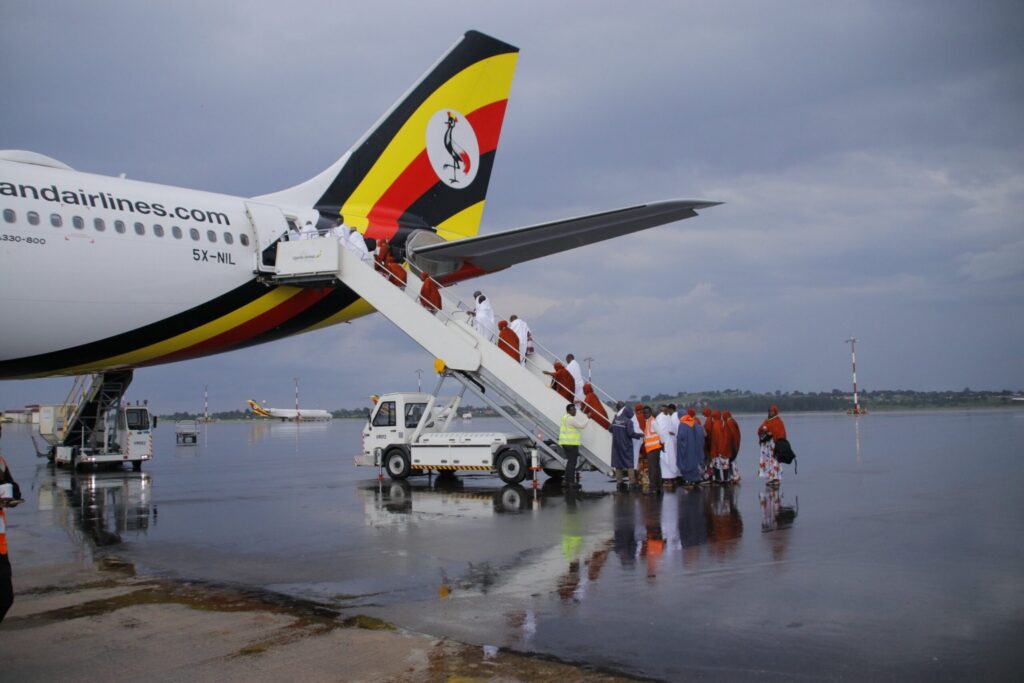
Uganda finally irked a deal to boost its airline fleet by procuring 10 more Boeing passenger planes .
This came after Uganda Airlines signed a Shs3.7 trillion deal with American manufacturer Boeing to acquire the new aircrafts.
The agreement was signed in the presence of President Museveni on June 10, with Boeing set to supply the national carrier as part of its long-term growth strategy.
Acting Chief Executive Officer of Uganda Airlines, Mr Girma Wake, signed on behalf of the airline, while Boeing Executive Vice President and Head of Sales for Africa, Mr Anbessie Yitbarek, signed on behalf of the supplier.
Under the agreement, Uganda Airlines will acquire eight Boeing passenger aircraft, each with a seating capacity of 294 passengers, alongside two cargo freighters comprising a Boeing 767 wide-body converted freighter and a Boeing 737 Boeing Converted Freighter.
Officials said the acquisition forms part of a broader government strategy to expand the national carrier’s fleet, increase direct international connections, boost tourism and trade, and position Uganda as a key aviation hub in the region.
Works and Transport Minister Fred Byamukama described the project as a strategic investment that will enhance Uganda’s connectivity with the rest of the world.
“It is a very expensive project, but the President said that we have no other option. We need to build our own airline. That is how Uganda can be connected to the rest of the world,” he said.
He noted that the first phase of the agreement will involve the delivery of four large passenger aircraft before the remaining aircraft are delivered.
“Today we have signed the contract, and they will first deliver four aircraft, each with the capacity to carry 294 passengers at once,” he said.
The ministry in March secured Shs422.26 billion to support the expansion of Uganda Airlines’ fleet, at a time when the national carrier was grappling with aircraft shortages and operational disruptions on key international routes. The funding, part of a supplementary request of Shs1.696 trillion approved in December last year, was earmarked for the acquisition of 10 new aircraft aimed at strengthening the airline’s capacity and route network.
The airline has in recent months faced fleet constraints that affected its long-haul operations, including the temporary suspension of some international routes, and has been operating with a limited number of aircraft, making it vulnerable to disruptions caused by maintenance schedules and technical issues.
In February the airline was forced to cancel flights to Nigeria, London and Mumbai in India after some of its aircraft developed mechanical issues. This came after two of Uganda Airlines’ long-haul A330neo jets, which operate routes to the UK, UAE, India and Nigeria, were taken out of service for unscheduled maintenance.
By the time of the cancellation, the airline’s A330neo had been grounded since January 11 and required a new or spare engine. Another A330neo, grounded since February 19 following an engine borescope inspection, revealed cracks on the engine blades and required maintenance repairs.
As part of solutions to bridge the aircraft gap, the airline secured a Boeing Dreamliner from Ethiopian Airlines and temporarily resumed long-distance flights, underscoring the urgency of fleet expansion.
The money, secured through borrowing, was reflected in the Ministry of Finance’s February Performance of the Economy report. The report indicates that, as a result of the borrowing, government operations during February resulted in net borrowing of Shs1.22 trillion, exceeding the programmed target of Shs985.85 billion.
At the signing ceremony, Mr Byamukama said the expansion will significantly reduce Uganda’s dependence on transit hubs in other countries and increase direct flights into the country.
“This means Uganda will be connected directly to the rest of the world. We shall bring many investors directly to Uganda. Previously, investors had to transit through other countries and make several stopovers. With the addition of these aircraft, we shall have more direct routes and connections,” he said.
He disclosed that government is expected to make an initial payment of Shs460 billion as part of the implementation process.
“Tomorrow, we are going to make the first deposit of Shs460 billion. The entire project will cost about Shs3.7 trillion. This money comes from taxpayers’ contributions through government revenue collections, which the President directed should be invested in expanding Uganda Airlines,” he explained.
The minister emphasized that the aircraft acquisition aligns with government’s broader infrastructure development agenda, which includes the expansion of Entebbe International Airport and the completion of Kabalega International Airport in Hoima.
He expressed optimism that the investments would significantly increase tourist arrivals and enhance Uganda’s competitiveness in international aviation over the next decade.
“We are finalizing Kabalega Airport and expanding Entebbe Airport. We know that within the next ten years, Uganda will be where it should be in terms of aviation development,” Byamukama said.
He also revealed government plans to eventually introduce domestic air services to improve connectivity within Uganda.
“Once we stabilize the expanded international operations, we shall embark on domestic flights so that Ugandans can easily fly to destinations such as Gulu, Kotido, Kidepo and Mbarara,” he added.
Byamukama credited President Museveni’s leadership and strategic vision for driving the country’s aviation development agenda.
“We thank the Government of Uganda and His Excellency the President for his wise leadership and for continuously giving directives that place Uganda on the map and expand the country’s economic development,” he said.
The signing ceremony also marked the beginning of what both parties described as a long-term partnership between Uganda Airlines and Boeing.
Boeing Vice President of Sales for Africa, Anbessie Yitbarek, pledged the company’s commitment to supporting Uganda Airlines beyond aircraft supply through technical expertise, training and capacity-building programmes.
He said Boeing would work closely with Uganda Airlines to ensure sustainable growth and operational excellence as the airline expands its fleet and route network.
According to Uganda Airlines, the planned acquisition will substantially increase the airline’s capacity to serve regional, continental and intercontinental markets while supporting Uganda’s economic transformation agenda.
The airline noted that the additional aircraft will facilitate trade, tourism, investment promotion and cargo transportation, directly contributing to the implementation of Uganda Vision 2040 and the country’s aspiration of attaining sustainable middle-income status.