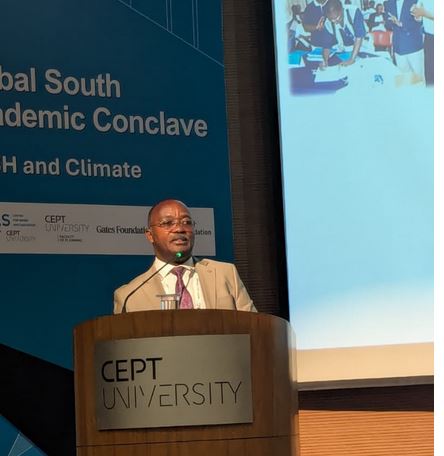
Ahmedabad, India — The Managing Director of Uganda’s National Water and Sewerage Corporation (NWSC), Eng. Dr. Silver Mugisha, has urged public utilities in the Global South to rethink how they operate, saying survival now depends on shifting from purely engineering-driven institutions to customer-focused service organizations.
Dr. Mugisha was speaking at the Global South Academic Conclave (GSAC) 2026 hosted at CEPT University on Friday, February 6, where he shared NWSC’s transformation story as a case study in building high-performing public enterprises under pressure from climate change and rapid urbanization.
He told delegates that utilities in developing regions are positioned at the crossroads of climate resilience, governance, public financing and social inclusion, making reform unavoidable.
Tracing NWSC’s journey, Dr. Mugisha explained that the utility had moved from a near-collapse before 1998—marked by poor service coverage and weak finances—through deep institutional reforms, to its current phase of rapid expansion.
Today, NWSC operates in more than 287 towns, compared to just 23 in 2013. It manages over one million water connections, serving an estimated 22 million people. Over the past decade, annual revenue has grown from UGX 170 billion to about UGX 622 billion.
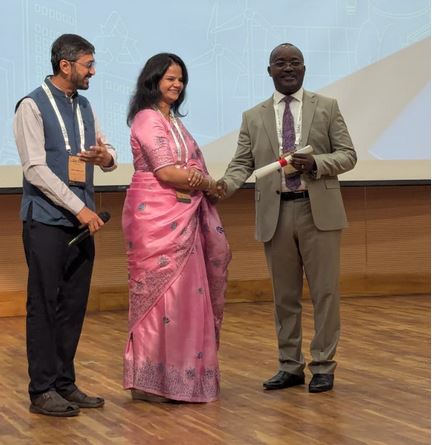
“Engineering builds infrastructure, but service delivery builds trust,” Dr. Mugisha said, stressing that public confidence is as important as physical assets.
He attributed the corporation’s progress to a business-oriented management model that emphasizes efficiency, accountability and equity. Central to this approach is NWSC’s performance-based contracting system, which sets measurable targets at corporate, regional and individual staff levels.
According to Dr. Mugisha, these performance contracts have reshaped staff attitudes, encouraging financial discipline and a culture that treats the utility as a self-sustaining business.
Digital innovation has also played a major role. By developing in-house digital solutions rather than relying entirely on costly imported systems, NWSC has improved real-time monitoring, data-driven decision-making, billing efficiency and the reduction of non-revenue water.
Despite the gains, Dr. Mugisha acknowledged persistent challenges. Climate variability remains a major threat, increasing water insecurity and creating shocks that infrastructure development struggles to match. Rapid urban growth and expanding informal settlements further complicate efforts to achieve universal water and sanitation access.
“Success doesn’t mean there are no problems,” he noted. “It means having better tools to deal with them.”
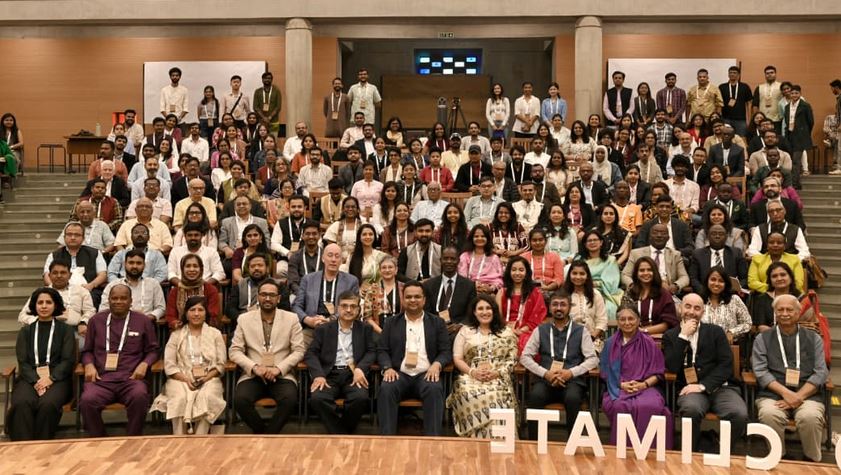
He highlighted a major imbalance between water supply and sewerage development, explaining that sanitation infrastructure is far more expensive and generates lower cost recovery, yet remains critical for public health. NWSC, he said, must constantly balance affordability for consumers with the need to remain commercially viable.
To strengthen decision-making, Dr. Mugisha revealed that NWSC has set up a Strategic Research Committee to ensure policies are guided by evidence. He cited a recent study assessing the accuracy of 1,200 water meters as an example of how research directly informs operational improvements.
Calling on universities and researchers, Dr. Mugisha appealed for closer collaboration between academia and utilities, urging scholars to focus on practical solutions rather than purely theoretical work. He emphasized the need to support grassroots innovation and scale technologies that respond to real challenges in the Global South.
“We must build bridges between the classroom and the field,” he said, adding that engineering innovation should drive the future of water and sanitation services.
Under its Corporate Plan 2024–2027, NWSC aims to expand operations to 350 towns and increase service coverage to 26 million people by 2030. The strategy prioritizes climate stewardship and equitable access, particularly for residents of informal settlements who face the greatest water risks.
Dr. Mugisha concluded that leadership and the courage to implement reforms will ultimately determine the future of water and sanitation in developing countries, noting that how utilities manage people and relate to customers matters as much as technical expertise.
During the summit, NWSC’s Senior Manager for Performance Management and Staff Development, Martin Kalibbala, discussed the utility’s data-driven innovations for WASH and climate resilience. Meanwhile, Ms. Penninah Nabireeba, Branch Manager at Kampala Water’s Industrial Area, shared practical success stories during a session on best practices in urban water operations.
NWSC’s progress, delegates heard, has also been strengthened by research partnerships with institutions such as CEPT University, the Gates Foundation, CRDF and the Viega Foundation, which continue to support faster and more inclusive service delivery.