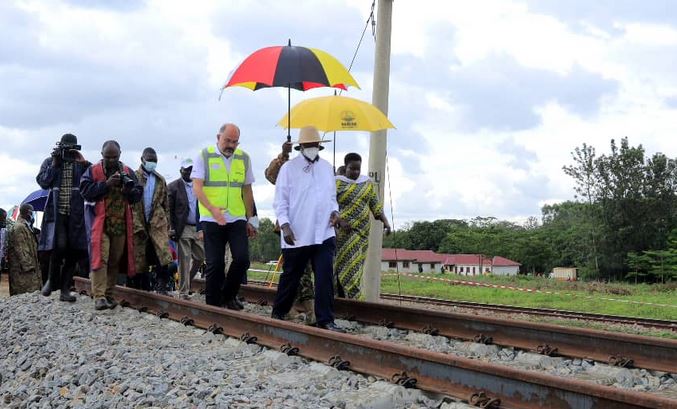
By Joseph Kiggundu
KISUMU, Kenya – Yoweri Museveni and William Ruto are expected to meet on March 20 to officially launch construction of a major Standard Gauge Railway (SGR) extension aimed at strengthening regional trade and connectivity.
The groundbreaking ceremony in Kisumu will mark the start of an ambitious infrastructure project designed to link the Port of Mombasa to inland East Africa, with a direct connection to Uganda.
The multi-billion-dollar project will extend Kenya’s existing railway from Nairobi through Naivasha to Malaba, before continuing onward to Kampala. The total cost is estimated at $8.5 billion, with Kenya’s section projected at $5.5 billion and Uganda’s portion at about $3 billion.
Uganda has already taken initial steps toward implementation, securing early financing and contracting Turkish construction firm Yapi Merkezi to carry out preliminary works, including soil testing and route mapping along the 273-kilometre Malaba–Kampala stretch.
Officials say the railway is expected to address long-standing transport challenges faced by Uganda as a landlocked country, improving access to international markets through the Kenyan coast. Once completed, the SGR is projected to handle up to 30 million tonnes of cargo annually.
According to Kenyan authorities, the new rail system will significantly cut travel time between Kampala and Nairobi—from around 14 hours by road to about four hours by rail. Transport costs for goods are also expected to drop by roughly 35 percent, enhancing the competitiveness of exports from the region.
The project builds on a bilateral agreement signed in March 2025, under which both countries committed to aligning technical standards to ensure seamless rail connectivity.
President Ruto has previously described the railway as part of a broader strategy to strengthen regional integration within the East African Community, with future plans to extend the line to the Democratic Republic of the Congo.
In Uganda, the SGR is also expected to ease pressure on public finances by reducing heavy reliance on road transport, which has been costly to maintain. Waiswa Bageya, Permanent Secretary at the Ministry of Works and Transport, noted that shifting cargo to rail will not only cut maintenance costs but also improve road safety, as thousands of fatalities are recorded annually on Ugandan roads.
Project officials say construction activities are already gaining momentum, with compensation for affected communities reportedly completed in several districts along the route.
The long-term vision for Uganda’s railway network spans over 1,700 kilometres, with planned extensions to South Sudan, Rwanda, and the Democratic Republic of the Congo, positioning the SGR as a key driver of regional trade and economic growth.