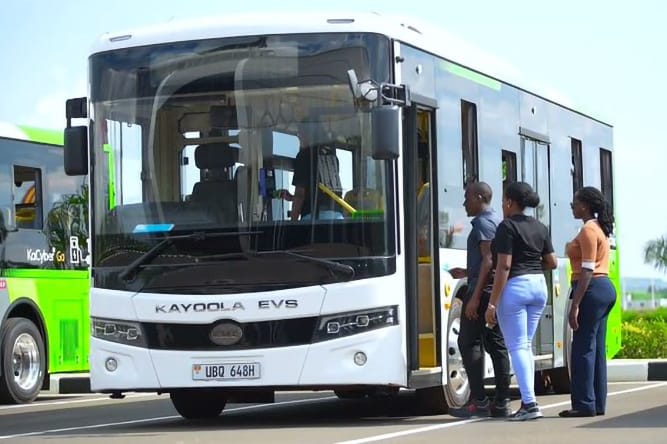
KAMPALA.The government has rolled out the E-Bus Xpress service in Kampala City .
This signals a fresh attempt to modernise urban public transport and reduce the city’s dependence on informal taxis and boda bodas.
The electric bus service, unveiled as part of wider efforts to reduce congestion, modernise mobility and cut transport emissions in the capital, will initially operate along key city routes with fares starting as low as Shs800.
Officials say the service is designed to offer commuters a safer, cleaner and more organised alternative to Kampala’s chaotic taxi-dominated transport network.
Under the newly announced fare structure, passengers travelling from City Square to Nakawa or Wandegeya will pay Shs800, while trips to Ntinda and Bukoto will cost Shs1,500. Additional routes include Nakawa to Ntinda and Bukoto to Ntinda, both charged at Shs800.
The fares are fixed and will not fluctuate depending on traffic, weather or passenger demand, marking a major departure from the unpredictable pricing common in Kampala’s informal commuter system.
The buses will also introduce fully cashless payments, with commuters expected to pay through MTN MoMo using 16522# or Merchant Code 594434, while Airtel Money users will pay through Code 4405648.
Officials described the system as part of a broader transition toward smart mobility, promising air-conditioned electric buses equipped with Wi-Fi, improved passenger comfort and lower environmental impact.
The launch comes as East African cities increasingly shift toward structured and technology-driven public transport systems, with Rwanda emerging as a key regional example.
Neighbouring Rwanda recently approved sweeping reforms in Kigali that will require buses to operate on fixed schedules similar to airline departures, eliminating the long-standing practice of waiting for buses to fill before departure.
Under that model, buses are expected to leave terminals on time, with delays tightly regulated through a central digital system.
The Kigali reforms have intensified debate across the region about why Uganda has repeatedly struggled to establish a functioning mass transit system despite years of announcements, pilot projects and public investment.
Uganda’s transport history has seen several stalled or collapsed initiatives, including Pioneer Easy Bus and later Tondeka Metro, which were initially presented as solutions to Kampala’s worsening traffic congestion but later failed due to financial difficulties, management disputes, weak regulation and fragmented planning.
For years, Kampala has remained dependent on commuter taxis and boda bodas operating in an informal environment without designated stops, reliable schedules or strict route discipline.
Transport analysts argue that earlier bus systems struggled partly because they were introduced into a road environment still dominated by commuter taxis and motorcycles competing aggressively for passengers.
Unlike Kigali, which has gradually introduced protected corridors and dedicated lanes for buses, Kampala’s road network remains largely unstructured and heavily congested.
One of the biggest weaknesses in Uganda’s previous public transport attempts has been the absence of dedicated bus infrastructure.
Without priority lanes, buses were forced into the same traffic as all other vehicles, making them slower and less attractive compared to taxis and boda bodas.
Officials involved in the E-Bus Xpress rollout believe the new model can succeed if supported by stronger urban transport reforms, route protection and digital monitoring systems.
The launch also aligns with Uganda’s growing electric mobility ambitions, boosted by the recent international recognition of the Made-in-Uganda Kayoola E-Coach developed by Kiira Motors Corporation.
In December 2025, the electric coach completed the first leg of the Pearl to Cape Electric Expedition, travelling more than 7,000 kilometres across six African countries before reaching Cape Town.
The expedition was widely celebrated by Ugandan officials as evidence that locally engineered electric mobility systems can perform reliably across diverse African terrains and climates.